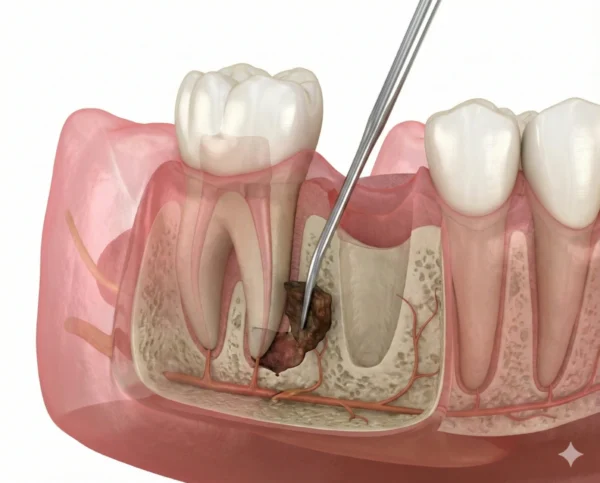
An apicoectomy is a small surgery to remove the tip of a tooth root and any infection around it, used when a root canal has not fully cleared an infection. Cyst removal takes out a fluid-filled sac that has formed in the jaw, often around a tooth root.
At a glance
- What it is
- Minor surgery on the root tip of a tooth, or removal of a cyst in the jaw
- Numbing
- Local anaesthetic in the area being treated
- Time or visits
- Usually one visit for the procedure, with healing over the following weeks
- Aftercare
- Rest, soft food, and a follow-up visit or X-ray to check healing
- Cost
- Depends on the tooth and how much treatment is needed. Your dentist tells you before starting.
What these treatments are
Sometimes a tooth that has already had root canal treatment keeps getting infected at the tip of the root, often because bacteria are still trapped there or the root shape made it hard to clean fully during the root canal. An apicoectomy removes the very tip of the root along with the infected tissue around it, and seals the end of the root so infection cannot get back in. A dental cyst is a slow-growing, fluid-filled sac that can form near a tooth root, usually because of a long-standing infection or a tooth that never came through properly. It does not always cause pain, but it can press on nearby teeth or bone, so it is generally removed once found.
Signs and when these are needed
- Ongoing pain, tenderness or a small pimple-like bump on the gum near a tooth that has already had root canal treatment
- Swelling that keeps coming back around one tooth
- A cyst or unusual area found on an X-ray, sometimes with no symptoms at all
- A tooth that feels tender to bite on, weeks or months after earlier treatment
What happens step by step
- Examination and X-ray. The dentist checks the tooth and takes an X-ray at the clinic to see the root tip or the cyst clearly, and may refer you to a specialist for this procedure.
- Numbing. Local anaesthetic is given to the area.
- Access. A small opening is made in the gum to reach the root tip or the cyst.
- Removal. The infected tissue, the last few millimetres of the root, or the cyst is removed, and the area is cleaned.
- Closing up. The gum is closed with fine stitches, and you are given instructions for healing at home.
- Follow-up. A later visit, sometimes with another X-ray, checks that the area is healing well.
After treatment
- Some swelling, bruising or discomfort in the first few days is normal.
- Eat soft food and chew on the other side while the area heals.
- Take any medicine as advised, and use an ice pack on the cheek if swelling is uncomfortable.
- Avoid smoking or chewing tobacco and paan or gutka, which slow healing.
- Go back for the follow-up visit, since healing of the bone can take a few months to show fully on an X-ray.
Risks and other options
As with any minor oral surgery, there can be swelling, bruising, and some risk of infection or slow healing. Occasionally the treated tooth still does not settle and further treatment, or removal of the tooth, may be needed. For a tooth that cannot be saved, extraction with a replacement such as a bridge or an implant is another option, and the dentist will discuss this with you if it applies. See our root canal treatment page and tooth extraction page for more on those treatments.
When to get urgent help
See your dentist soon if pain or swelling is getting worse after the procedure instead of settling. Go to the nearest hospital straight away (or call 112) if you have swelling of the face or neck, swelling that makes it hard to breathe or swallow, or a fever together with tooth or jaw pain. Do not wait for an appointment.
Common questions
Will it hurt?
The area is numbed during the procedure. Afterwards there can be some soreness or swelling for a few days, and the dentist can advise on pain relief.
Is an apicoectomy the same as a root canal?
No. Root canal treatment cleans the inside of the tooth from the crown. An apicoectomy is a small surgery from outside, at the tip of the root, usually done after a root canal has not fully solved an infection.
Can a cyst come back?
It is uncommon once removed, but the dentist may want a follow-up X-ray to confirm the area has healed fully.
Do I need to see a specialist?
Some cases are referred to a specialist for these procedures. Dr. Anjali will advise what is right for your case.
How long does recovery take?
Most people feel better within a few days, though full healing of the bone underneath takes longer and is checked at a follow-up visit.
How much does it cost?
It depends on the tooth and how much treatment is needed, so we can only tell you after examining you. Dr. Anjali will explain the cost before starting.
Apicoectomy and cyst removal at Gangtok Dental Clinic
Dr. Anjali Gupta sees patients at Gangtok Dental Clinic and has more than 8 years of experience in dentistry. She will examine your tooth or the area concerned first, explain what she finds, go through the options and the cost with you, and nothing is started until you are ready to go ahead.
We are open every day from 10:00 AM to 8:00 PM. Call or message us on WhatsApp at +91 82106 99271 to book a check. Our address is on the contact page.
This page gives general information about the treatment. It is not a diagnosis or medical advice, and what you need depends on an examination by your dentist. Please read our Medical Disclaimer.