A root canal treatment is done when the inner part of a tooth, called the pulp, has become infected or badly inflamed. The aim is to save your own tooth instead of taking it out.
At a glance
- What it treats
- A tooth whose pulp is infected or inflamed
- Numbing
- Local anaesthetic, so the tooth is numb and you stay awake
- Visits
- One or two visits is common. Some teeth need more.
- Afterwards
- The tooth is usually protected with a filling or a crown
- Cost
- Depends on your tooth. Your dentist tells you before starting.
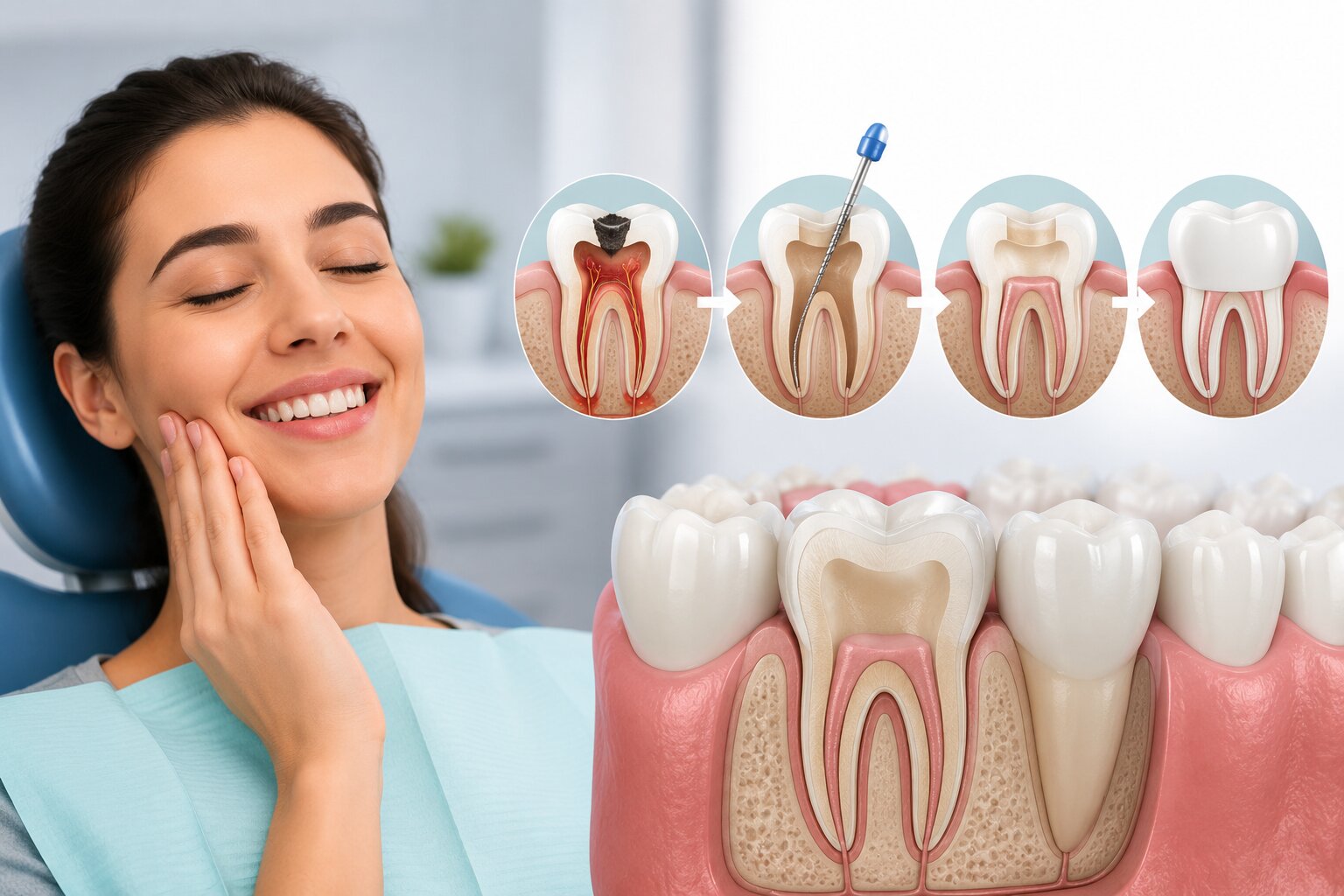
What is a root canal treatment?
Inside every tooth is a soft tissue called the pulp. It holds nerves and blood vessels. If bacteria reach the pulp, through deep decay, a crack or chip, or an injury to the tooth, it can become infected.
In a root canal treatment, the dentist removes the infected pulp, cleans and disinfects the inside of the tooth, then fills and seals it. The tooth stays in your mouth and you can carry on using it.
Signs you may need a root canal
- Pain when you bite or chew
- Sensitivity to hot or cold that lingers after the food or drink is gone
- A swollen or tender gum near the tooth
- A small pimple-like bump on the gum
- A chipped or cracked tooth
- A tooth that has turned darker
- Deep decay
Some infected teeth cause no pain at all. That is why the tooth has to be examined, and usually X-rayed, before anyone can say whether you need a root canal. Only a dentist can tell you.
What happens during treatment
- Examination. The dentist looks at the tooth and asks about your symptoms. An X-ray is usually needed to see the roots and the bone around them.
- Numbing. A local anaesthetic numbs the tooth and the area around it. You stay awake.
- Opening the tooth. The dentist makes a small opening in the top of the tooth to reach the pulp.
- Cleaning. The infected pulp is removed. The narrow channels inside the roots, called canals, are cleaned, shaped and disinfected.
- Filling and sealing. The canals are filled with a rubber-like material called gutta-percha and sealed. A temporary filling may be placed if you need to come back another day.
- Protecting the tooth. A tooth that has had a root canal is restored with a permanent filling or a crown.
How long does it take?
Many teeth are treated in one or two visits. Some need more, especially when the infection is large or the tooth has several canals. A single visit can take an hour or two. Your dentist will tell you what to expect for your tooth.
After the treatment
- The numbness usually wears off in a few hours. Wait until it has gone before you eat, so you do not bite your cheek or tongue.
- The tooth and the gum around it can feel sore or a little swollen for a few days. Take pain relief only as your dentist advises.
- Try not to chew hard food on that tooth until it has its permanent filling or crown.
- Keep brushing and flossing as usual, and come back for any follow-up visit you are given.
Get in touch with us if the pain gets worse instead of better, if the swelling grows, or if your bite feels uneven.
Risks and other options
Every treatment has risks, and your dentist should explain them to you before starting. With a root canal:
- The infection may not clear completely, and the tooth may need to be treated again.
- A treated tooth can be more fragile than before, which is why a crown is often advised, especially for back teeth.
- Sometimes a tooth cannot be saved and has to be removed.
The main alternative is to have the tooth taken out. A missing tooth can then be replaced with a bridge, a denture or an implant. Leaving an infected tooth untreated is not a safe option, because the infection can spread to the jaw and face.
When to get urgent help
Go to the nearest hospital straight away (or call 112) if you have swelling of the face or neck, swelling that makes it hard to breathe or swallow, or a fever together with tooth pain. Do not wait for an appointment.
Common questions
Will it hurt?
The tooth is numbed with local anaesthetic, so most people feel pressure or vibration rather than pain. If you feel any pain during treatment, tell the dentist straight away and they will stop and numb the tooth further. The tooth can feel sore afterwards, and this usually settles within a few days.
Will I need a crown afterwards?
Often, yes, particularly for back teeth that do most of the chewing or teeth that have lost a lot of their structure. Your dentist will tell you whether your tooth needs one.
How much does it cost?
The cost depends on which tooth it is and how many visits it needs, so we cannot give a fair figure without seeing the tooth. Dr. Anjali will explain the cost before starting anything.
Can I go to work afterwards?
Many people can return to normal activities once the numbness wears off. Ask your dentist what is right for you.
What happens if I leave an infected tooth alone?
The infection can spread to the jaw and face, and the tooth may eventually have to be removed.
Is a root canal safe?
It is a standard dental treatment that is carried out widely. Your dentist will go through the benefits and risks for your own tooth before you decide.
Root canal treatment at Gangtok Dental Clinic
Dr. Anjali Gupta sees patients at Gangtok Dental Clinic and has more than 6 years of experience in dentistry. On your first visit she will examine the tooth and explain what she finds. She will go through your options and the cost with you, and nothing is started until you are ready to go ahead.
We are open every day from 10:00 AM to 8:00 PM. Call or message us on WhatsApp at +91 82106 99271 to book an examination. Our address is on the contact page.
This page gives general information about the treatment. It is not a diagnosis or medical advice, and what you need depends on an examination by your dentist. Please read our Medical Disclaimer.